Showing posts with label conservation. Show all posts

Wednesday, January 9, 2013

SAY IT ISN'T SO DR. OZ!


Marion Pellicano Ambrose


While health food gurus and cosmetic companies are pushing the benefits of palm oil, the demand for this product is actually pushing wildlife and local communities out of their tropical forest habitats. Even the famous Dr. Oz had recommended the use of Palm Oil, though I’m sure he was unaware of the disastrous consequences to wildlife and the environment. The use of palm oil as a biodiesel is on the rise. In addition, it is significantly contributing to the release of climate warming gases.

Indonesia, the leading supplier of palm oil in the world, is now emitting more greenhouse gases than any other country except China.


FROM THIS                                                                                         TO THIS
 

Among the endangered species affected by deforestation due to palm oil production are the Sumatran Tiger and the Orangutan. As you may know, I have a special interest in the latter.  If you had the opportunity, as I have had, to look into the eyes of this magnificent creature, you would never dream of using palm oil.

 
PONGO

Orangutans are divided into two species, the Bornean and the Sumatran . Both are native inhabitants of Asia. The redish-brown hair of the Orangutan is absolutely striking, and the adult male cheek pads are impressive and give them an attractive round face. One of the most heartwarming things about driving on to the property at The Center For Great Apes in Wachula, Florida, is hearing the distinctive long calls of the males, attracting females or intimidating rivals. It echoes through the forested compound like a song.


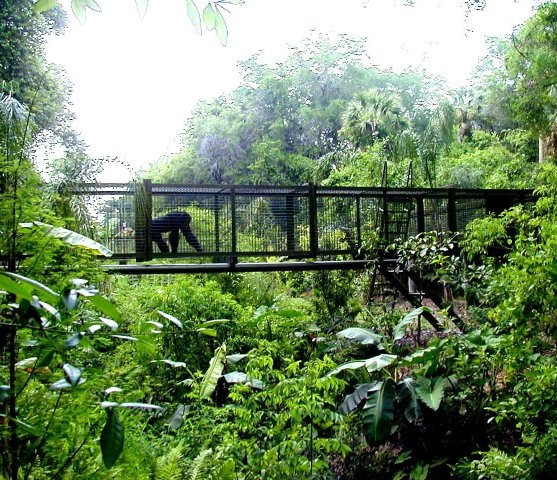
As you walk down the pathways around and under the system of overhead chutes that allow the orangutans and chimpanzees to wander all over the  acre grounds, you feel their joy in being up in the trees or in their gigantic open structures that mimic their natural habitat. What strikes me most is the intelligence of these primates. They love to play with toys and show off for passers by. Some do a special dance, while others seem to grin as they fill their mouths up at their fountain and spit water at you. The seem to get the humor in it all.

 I remember on my first visit, a young female Orang followed me everywhere I walked. She seemed to be amused and it was as if she wanted to play with me. On taking a closer look, I noticed she had no arms. This was Mari. She was born in a drug research facility and lost her arms as an infant. Here, at the CFGA, she lives a happy and fulfilling life, learning to do everything she needs with her feet. At my last visit, she was happily living with her mate, the HUGE, handsome Pongo. (By the way, a docent later told me that the reason Mari followed me around was because of my redish-brown hair. She thought I was another Orangutan!)

 I write about these amazing animals so you will feel the personal connection that I do. They are SO smart and feel love, sadness, joy and anger. They like to play, be with their families, learn and enjoy life, just as we do. These particular primates have suffered much in their lifetimes, in circuses, show business, and research labs. Some were bought as exotic pets and when their owners found out what we all should know, wildlife belongs in the wild, they were sold or caged to contain them. The happiest day for each of these creatures was when they were brought to the CFGA.

Unfortunately, the story does not have a happy ending for all Orangutans. Those living in the forests of Indonesia are forces out of their habitat. Some Palm Farmers, in an attempt to protect their new palm oil plantations form the animals returning, shoot, burn and beat the creatures. Others die from lack of food and water. They don’t have a beautiful compound waiting for them. They are destined to die a miserable death. Such a tragedy for so noble and intelligent a being- and so unnecessary.


What can you do?

*STOP buying products containing Palm Oil. Look closely at labels. Palm Oil is in cosmetics, candy, soap and pastry dough , among other things.


*Educate yourself and others about endangered species, such as the Orangutan and Sumatran Tiger.


*Support organizations that protect and defend endangered animals.
http://animals.about.com/od/wildlifeconservation/p/natureconservancy.htm
 http://animals.about.com/od/wildlifeconservation/p/worldwildlifefund.htm
http://www.centerforgreatapes.org/

*Support organizations that rescue these animals and give them back their dignity and lifestyle as much as possible. (Such as the Center For Great Apes)
http://www.centerforgreatapes.org/
 
*Follow the advise of these two sages:

 "Live simply so that others may simply live." Mother Elizabeth Seton

"Become a possibilitarian. No matter how dark things seem to be or actually are, raise your sights and see possibilities - always see them, for they're always there. " ~Norman Vincent Peale
Friday, August 5, 2011

HAPPY NATIONAL PARKS WEEK!

Marion Pellicano Ambrose

This week is National Parks Week. We celebrate the gifts of nature in their full grandeur all over the 50 United States. It’s important to preserve these monuments to our past and hope for our future. Check out Our Amazing Planet’s choices for 8 must see National Parks. I think ANY National Park that you can possibly visit is a MUST SEE! Enjoy!
                       Sandstone Arches - Arches National Park, Utah

            Moonbow at Yosemite Falls - Yosemite National Park, California
Old Faithful Geyser - Yellowstone National Park, Wyoming
Grand Canyon - Grand Canyon National Park, Arizona
Crater Lake - Crater Lake National Park, Oregon
Rainbow Bridge National Monument, Utah
Glaciers - Glacier National Park, Montana
Redwood Trees - Redwood National Park, California
All photos courtesy of National Parks Service.
Here is a sample of some of the National Parks in several states. To find the parks in your state go to:
National Parks in Florida
11 park sites were found in Florida.
National Parks in Maine
4 park sites were found in Maine.
National Parks in New York
26 park sites were found in New York.
National Parks in California
27 park sites were found in California.
National Parks in Illinois
6 park sites were found in Illinois.
National Parks in Texas
13 park sites were found in Texas.
National Parks in Tennessee
12 park sites were found in Tennessee.