Showing posts with label orangutans. Show all posts

Wednesday, January 9, 2013

SAY IT ISN'T SO DR. OZ!


Marion Pellicano Ambrose


While health food gurus and cosmetic companies are pushing the benefits of palm oil, the demand for this product is actually pushing wildlife and local communities out of their tropical forest habitats. Even the famous Dr. Oz had recommended the use of Palm Oil, though I’m sure he was unaware of the disastrous consequences to wildlife and the environment. The use of palm oil as a biodiesel is on the rise. In addition, it is significantly contributing to the release of climate warming gases.

Indonesia, the leading supplier of palm oil in the world, is now emitting more greenhouse gases than any other country except China.


FROM THIS                                                                                         TO THIS
 

Among the endangered species affected by deforestation due to palm oil production are the Sumatran Tiger and the Orangutan. As you may know, I have a special interest in the latter.  If you had the opportunity, as I have had, to look into the eyes of this magnificent creature, you would never dream of using palm oil.

 
PONGO

Orangutans are divided into two species, the Bornean and the Sumatran . Both are native inhabitants of Asia. The redish-brown hair of the Orangutan is absolutely striking, and the adult male cheek pads are impressive and give them an attractive round face. One of the most heartwarming things about driving on to the property at The Center For Great Apes in Wachula, Florida, is hearing the distinctive long calls of the males, attracting females or intimidating rivals. It echoes through the forested compound like a song.


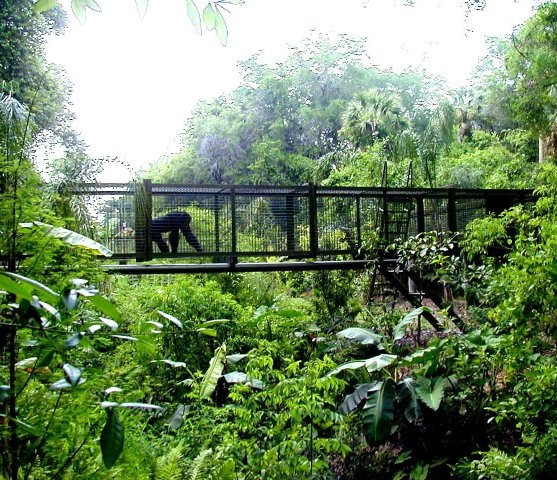
As you walk down the pathways around and under the system of overhead chutes that allow the orangutans and chimpanzees to wander all over the  acre grounds, you feel their joy in being up in the trees or in their gigantic open structures that mimic their natural habitat. What strikes me most is the intelligence of these primates. They love to play with toys and show off for passers by. Some do a special dance, while others seem to grin as they fill their mouths up at their fountain and spit water at you. The seem to get the humor in it all.

 I remember on my first visit, a young female Orang followed me everywhere I walked. She seemed to be amused and it was as if she wanted to play with me. On taking a closer look, I noticed she had no arms. This was Mari. She was born in a drug research facility and lost her arms as an infant. Here, at the CFGA, she lives a happy and fulfilling life, learning to do everything she needs with her feet. At my last visit, she was happily living with her mate, the HUGE, handsome Pongo. (By the way, a docent later told me that the reason Mari followed me around was because of my redish-brown hair. She thought I was another Orangutan!)

 I write about these amazing animals so you will feel the personal connection that I do. They are SO smart and feel love, sadness, joy and anger. They like to play, be with their families, learn and enjoy life, just as we do. These particular primates have suffered much in their lifetimes, in circuses, show business, and research labs. Some were bought as exotic pets and when their owners found out what we all should know, wildlife belongs in the wild, they were sold or caged to contain them. The happiest day for each of these creatures was when they were brought to the CFGA.

Unfortunately, the story does not have a happy ending for all Orangutans. Those living in the forests of Indonesia are forces out of their habitat. Some Palm Farmers, in an attempt to protect their new palm oil plantations form the animals returning, shoot, burn and beat the creatures. Others die from lack of food and water. They don’t have a beautiful compound waiting for them. They are destined to die a miserable death. Such a tragedy for so noble and intelligent a being- and so unnecessary.


What can you do?

*STOP buying products containing Palm Oil. Look closely at labels. Palm Oil is in cosmetics, candy, soap and pastry dough , among other things.


*Educate yourself and others about endangered species, such as the Orangutan and Sumatran Tiger.


*Support organizations that protect and defend endangered animals.
http://animals.about.com/od/wildlifeconservation/p/natureconservancy.htm
 http://animals.about.com/od/wildlifeconservation/p/worldwildlifefund.htm
http://www.centerforgreatapes.org/

*Support organizations that rescue these animals and give them back their dignity and lifestyle as much as possible. (Such as the Center For Great Apes)
http://www.centerforgreatapes.org/
 
*Follow the advise of these two sages:

 "Live simply so that others may simply live." Mother Elizabeth Seton

"Become a possibilitarian. No matter how dark things seem to be or actually are, raise your sights and see possibilities - always see them, for they're always there. " ~Norman Vincent Peale
Wednesday, June 29, 2011

MEET PONGO AND JOIN DRL'S TEAM TO HELP HIM AND THE CENTER FOR GREAT APES

Marion Pellicano Ambrose

Pongo is a cutie, don't you think?

Pongo is a handsome adult male orangutan whose cheek pads (also called flanges) have grown quickly as he has matured.  He started his life as an infant at a tourist attraction and was the first ape to be cared for at the sanctuary.
When he was nearly eight years old, Pongo was moved to his permanent sanctuary home in Wauchula where he has met and lived with three other orangutans, Christopher, Mari, and Pebbles.  Now that they are adults, Pongo still has a few play dates with Christopher, but like typical territorial male orangutans they sometimes compete for the attention of the females, Mari and Pebbles.  Currently Pongo lives full time with Mari.  They spend their days traveling through the forest woods in the elevated tunnel chute system or hanging around in their 35-foot tall habitat with large cypress-tree climbing structures. 
The orangutans have a wide variety of play materials including barrels, culverts, tires, fire hose swings, barge-rope vines, giant rubber tubs for pools, as well as more naturalistic toys such as tree branches, banana leaves, palm fronds, coconuts, bamboo poles, and sand piles.  Pongo has always liked playing in water and when he was younger, he used to drag one of his big tubs over to his drinking spigot and fill it with water to splash in.
But, now as a fully-developed adult male, Pongo has become more subdued in his play behavior.  He spends much more time alone watching the goings-on at the sanctuary from inside a large culvert, or from behind a shady tree in the overhead tunnels.  Pongo takes his blankets to make a nest inside his night house each night… but occasionally he likes to sleep outside.   The long, red hair on his back and arms has grown to nearly three feet and is extraordinarily beautiful.   
His favorite foods are spinach, Romaine lettuce, bananas, jakfruit, and butternut squash.  He absolutely HATES any foods with flour like crackers, bread, cookies, and pretzels.

The Center for Great Apes provides care with dignity in a safe, healthy, and enriching environment for great apes in need of lifetime care.  The annual cost for the care of one ape housed at the sanctuary is over $20,000.  The Center is home to 43 great apes and all the support for their care comes from members, individual donors, and grants from animal foundations.  The Center does not receive any government funding.

     Delayed Reaction Lounge has formed a Guardian  Team to help Pongo. Our goal is to raise $2,000 by his birthday on August 16th. If you would like to join our team and make  a donation to help Pongo, visit the link below and look for the Delayed Reaction Lounge Team.

“Until he extends the circle of his compassion to all living things, man will not himself find peace.”  ~Albert Schweitzer

https://bos.etapestry.com/fundraiser/CenterforGreatApes/pongo/donate.do